What is gamified habit tracking?
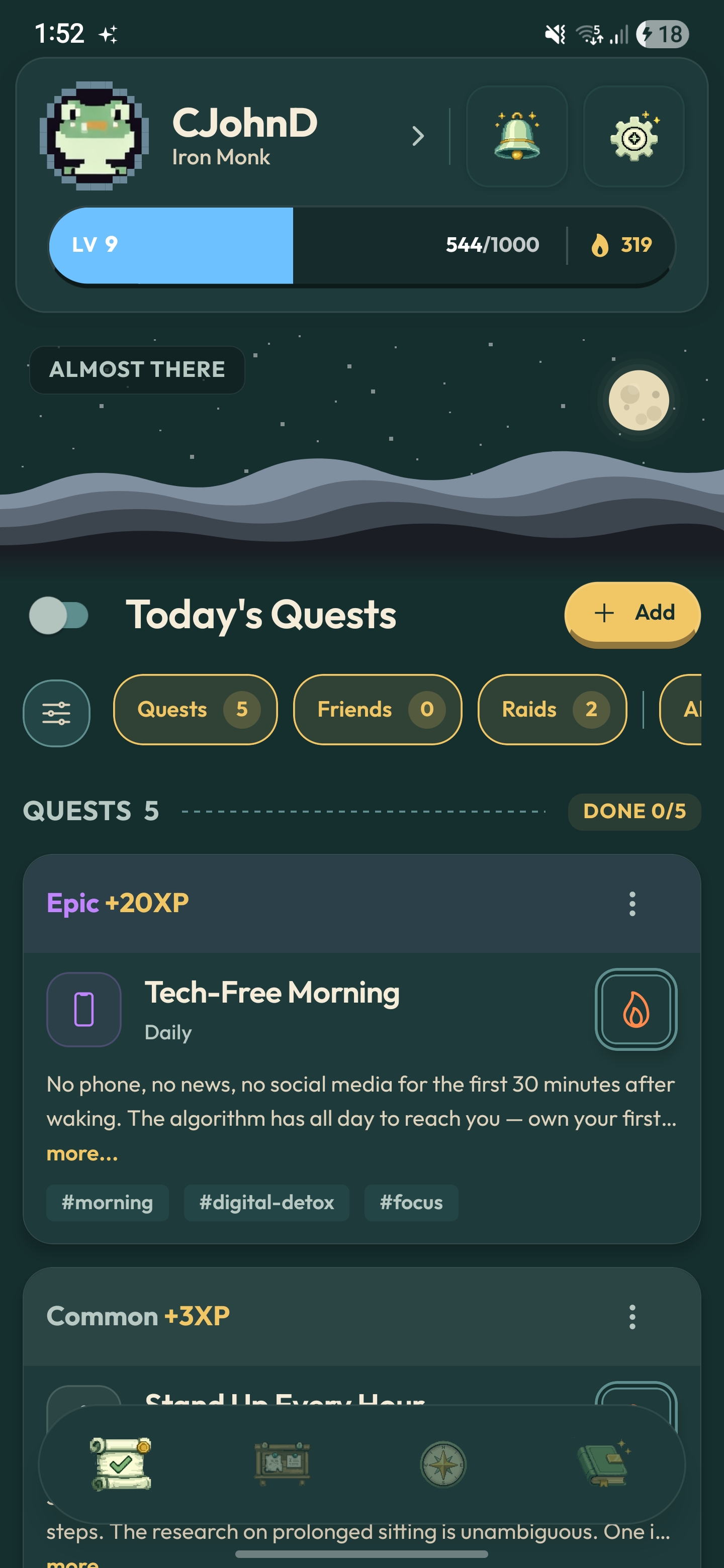
Gamified habit tracking gives ordinary actions the feedback loop of a game. “Walk for ten minutes” becomes a quest. Finishing it earns XP. Repeated effort grows a character, fills a progress bar, or helps a team beat a boss. The action is still real; the game layer simply makes the result visible now instead of weeks later.
That immediacy is the useful part. The fantasy theme is optional. If a number going up helps you start something that matters, the mechanic is doing its job. If preserving the number becomes more important than sleeping, resting, or being honest, the mechanic has taken over.
The four rules behind a habit game that stays kind
1. Reward the action, not the size of the action
“Write one sentence” and “write for an hour” can both be legitimate quests. The smaller version is not cheating; it is a deliberate low-friction doorway. Once you start, you may continue. If you do not, you still kept the promise you actually made.
2. Let progress accumulate
A missed day should not delete yesterday. In CheckMate, the streak only counts up; if you miss a day, it waits. There is no HP loss. That choice came from a simple observation while building the app: a comeback is useful data, while a reset to zero mostly records guilt.
3. Treat rest as part of the plan
A rest day and an abandoned goal are not the same thing. Marking rest explicitly makes that distinction visible. It also keeps the tracker honest: you can plan three runs a week without pretending that the other four days are failures.
4. Use other people for support, not surveillance
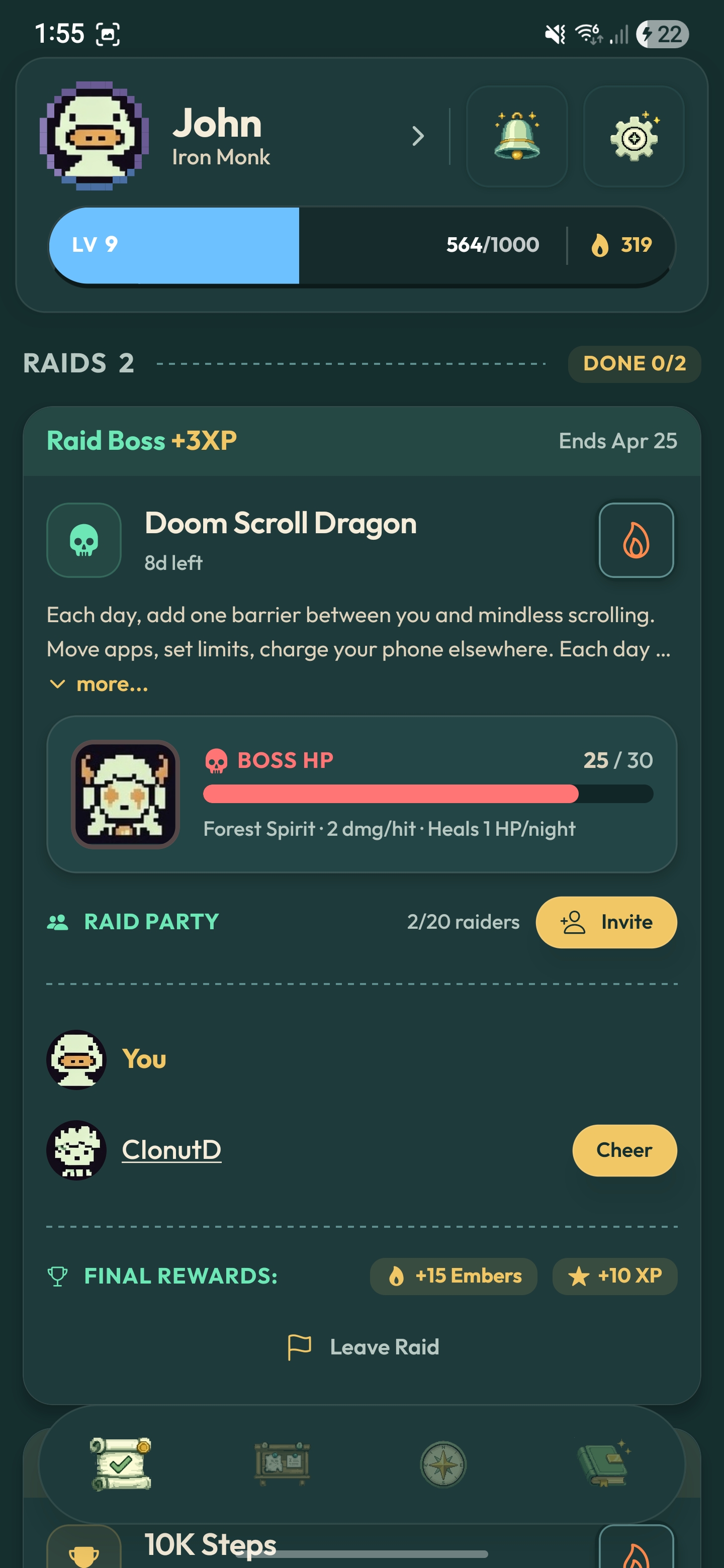
Shared accountability works best when everyone is contributing to something together. CheckMate raids frame check-ins as damage to a shared boss, growth in a co-op grove, tug-of-war progress, or endurance. Friends can help the party without turning into supervisors.
| Mechanic | Pressure-first version | Rest-positive version |
|---|---|---|
| Streak | Resets after one missed day | Preserves completed work and welcomes the next check-in |
| Difficulty | Every habit must be ambitious | The smallest honest version still counts |
| Friends | Watch whether you complied | Contribute toward a goal you share |
| Rewards | Become the reason for the habit | Make real progress easier to notice |
A seven-day way to start
You do not need to gamify your entire life on day one. Start with one behavior whose finish line is unambiguous.
- Choose one small action. “Read two pages” is clearer than “read more.”
- Pick realistic days. Three planned days can be more useful than seven imaginary ones.
- Define done before you begin. Remove the chance to move the goalpost later.
- Attach immediate feedback. Check it off, earn XP, or move a visible marker.
- Record rest honestly. Planned rest should not lower your consistency score.
- Invite a friend only if it helps. Share a goal; do not outsource permission or judgment.
- Review the system, not your worth. If the quest keeps failing, shrink or reschedule it.
Try it without installing anything
Use the free habit consistency tracker to mark completed days and planned rest. It calculates consistency and momentum locally in your browser.
Where friends change the loop
Solo tracking asks, “Did I do it?” Co-op tracking can ask, “What did our party move forward?” That shift matters on low-energy days. A small check-in can still help someone else, and their check-in can keep the shared goal alive when yours is not available.
How to choose a gamified habit tracker
Look past the theme and inspect what the system rewards. A good fit should let you answer yes to most of these:
- Can I define a genuinely small version of a habit?
- Can I schedule it for the days that make sense?
- Does a missed day preserve earlier progress?
- Can I use it alone without losing core functionality?
- If it has social features, do they encourage cooperation rather than shame?
- Can I export or protect personal reflections?
- Can I ignore the mechanics that do not help me?
CheckMate is the answer I built for myself: daily quests, XP and character growth, co-op raids, focus sessions, a private journal, and a Notice Board for community-made quests. It was built by one developer with ADHD, but it is a productivity tool—not a diagnosis or medical treatment. You can read the full story behind the app or see real screenshots.
Common questions
Do I need to care about RPGs for gamification to help?
No. The functional pieces are immediate feedback, visible progress, clear finish lines, and optional accountability. A fantasy wrapper can make those pieces more enjoyable, but it is not the mechanism itself.
What happens when I break a habit streak?
The calendar should tell the truth without turning it into a verdict. Keep the completed days, mark planned rest, and make the next action smaller if returning feels hard. In CheckMate specifically, a missed day does not reset the streak or remove HP.
Is CheckMate an ADHD treatment?
No. CheckMate is a habit and productivity app. It was shaped by the creator’s lived experience with ADHD, but it does not diagnose, treat, or replace professional care.
Can I use CheckMate without friends?
Yes. Personal quests, focus sessions, character progress, and the journal all work as individual tools. Raids and shared adventures are there when social energy helps.